


The shielding gas plays a crucial role in TIG welding. Its primary function is to protect the weld pool from atmospheric gases such as oxygen, nitrogen, and hydrogen, which can contaminate the weld and lead to defects like welding undercut, porosity, embrittlement, and discoloration. The inert gas creates a barrier around the weld pool, excluding these contaminants and ensuring a clean, high-quality weld.
How to choose the most suitable shielding gas for TIG welding? Is there a gas suitable for all materials that can be TIG welded?
Common Shielding Gases in TIG Welding
In TIG welding processes, the gas used must be inert to ensure stability and quality during welding. The most common shielding gas is pure argon gas, which provides stable and concentrated arc, good arc starting, and relatively low heat input and penetration depth. Additionally, the purity of argon gas should range from 99.9% to 99.999% to meet welding quality requirements.
In certain special cases, such as welding materials with good heat dissipation properties like thick plate aluminum alloys and copper, pure helium gas may also be used as a shielding gas. Helium gas allows for greater penetration depth and wider weld bead compared to argon. Mixing helium with argon at ratios of 30%, 50%, or 70% can increase the welding heat input. However, helium has relatively poor arc starting characteristics, so equipment’s arc starting performance should be taken into consideration when using helium.
Apart from argon and helium, other gases may be added in TIG welding:
- Hydrogen (H2)
- Nitrogen (N2)
- Nitric oxide (NO)
Hydrogen, when added in appropriate amounts, can improve the flowability of the weld pool and increase penetration depth, particularly beneficial for welding austenitic stainless steels to achieve brighter weld colors. However, it should be avoided when welding ferritic or ferritic-austenitic duplex stainless steels to prevent hydrogen embrittlement.
For welding high-alloy austenitic steels or super duplex steels, where there might be a loss of nitrogen during welding, nitrogen gas can be added as a shielding gas, especially when the filler wire has low or no nitrogen content.
The addition of nitric oxide can improve the work environment, remove ozone, and in some cases enhance arc stability. However, the amount of nitric oxide added should be kept low, such as 0.03%, to avoid adverse effects on the welding process.
Advantages of TIG Welding
Here are the main advantages of TIG welding:
High-Quality Welds
TIG welding achieves high-quality welding results with clean and aesthetically pleasing welds. The use of inert gas shielding effectively eliminates harmful gases such as oxygen, nitrogen, and hydrogen from affecting the welded metal, ensuring the purity and high quality of the welds.
Strong Stability
Since the tungsten electrode remains non-consumable during welding, the welding process maintains a constant arc length and consistent welding current, ensuring stability throughout the welding process.
No Splatter
During TIG welding, the inert gas shielding and stable arc prevent spatter, reducing contamination and waste during the welding process.
Wide Applicability
TIG welding is suitable for almost all metals or alloys, including carbon steel, stainless steel, aluminum alloys, nickel alloys, copper alloys, titanium alloys, etc. Additionally, it is particularly suitable for welding thin sheets, as it can weld normally even with a technical current of less than 10A.
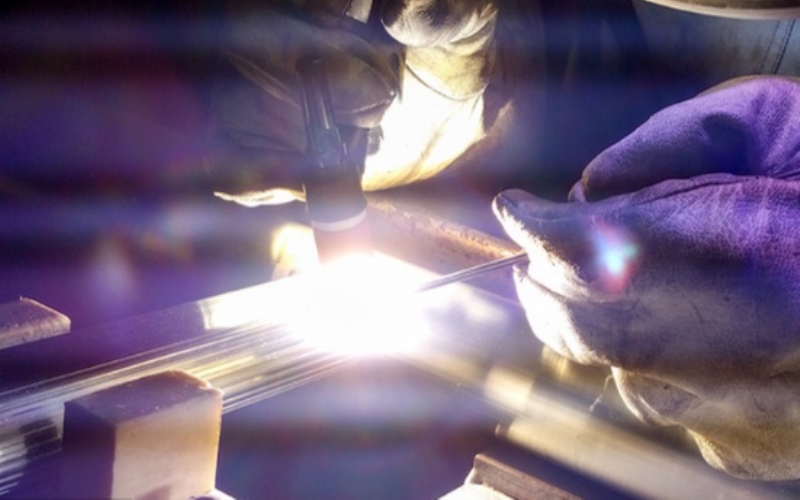
TIG Welding Technology
The characteristics of TIG welding mainly manifest in the following aspects:
1. Heat Source and Electrode
TIG welding utilizes a direct current (DC) arc as the heat source, with operating voltage typically ranging from 10 to 95 volts and currents reaching up to 600 amps. The electrode in TIG welding is typically made of tungsten, known for its high-temperature resistance and good conductivity. During welding, the electrode is grounded while the workpiece acts as the positive terminal.
2. Welding Quality
TIG welding is renowned for its high-quality welds. It is applicable to various metal materials, including carbon steel, stainless steel, aluminum alloys, etc., and can weld workpieces ranging from 0.1mm to over 10mm in thickness. TIG welding can achieve high-quality welds in various positions, such as flat, vertical, horizontal, and overhead. Due to the use of shielding gas, the welds exhibit high purity, aesthetic appearance, and minimal heat-affected zone.
3. Operation and Control
TIG welding operations require a relatively high level of skill from welders due to its precision. Next-generation TIG welding machines feature digital control systems, enabling preset current, arc stability control, and intelligent operation interfaces, thus making the operation simpler and more convenient.
4. Application Fields
TIG welding finds widespread applications in aerospace, nuclear energy, automotive manufacturing, shipbuilding, chemical engineering, medical devices, and other fields. For instance, in aerospace, TIG welding is utilized to manufacture high-precision and highly reliable components, while in automotive manufacturing, it is used for welding critical components such as car bodies and engines.
Conclusion
In summary, shielding gas plays a crucial role in TIG welding. In practical operation, welders need to choose appropriate protective gases and adjust gas flow rates based on factors such as welding materials, thickness, and position.
BoYi provides you with excellent TIG welding services. We have an experienced and skilled welding team to meet your demanding welding process requirements.
