

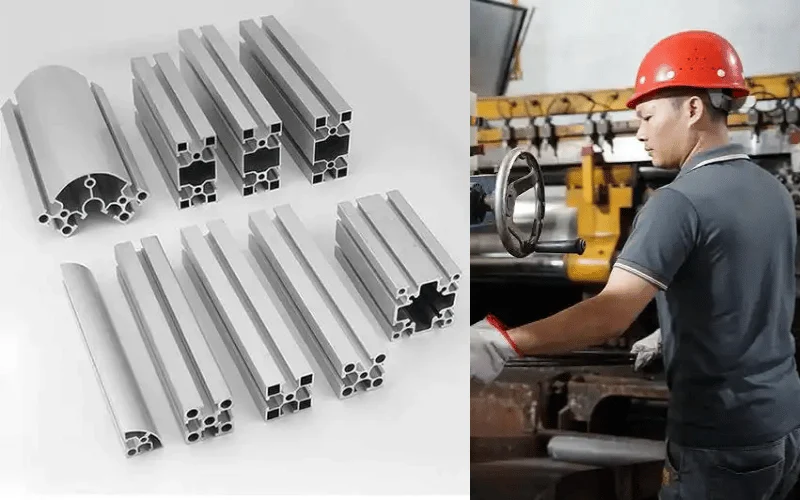
Choosing between aluminum, mild steel, and stainless steel often comes down to how the material is manufactured. Steel sections typically require cutting, forming, machining, and welding to achieve the desired cross-section, with each additional process increasing labor, production time, and the potential for dimensional variation. Aluminum, by contrast, is heated until it becomes plastic enough for extrusion, allowing a billet to be forced through a hardened steel die and emerge as a finished profile in continuous lengths, complete with grooves, channels, fins, and other integrated features. It is also approximately one-third the weight of mild steel and naturally corrosion-resistant without requiring paint or galvanizing. For manufacturers sourcing ready-to-use extrusion profiles, an Indonesia aluminum factory offers a more efficient production route than fabricating complex steel sections from raw stock.
PT Exalum Metal Indo has supplied Exalummetal industrial aluminum products to industrial customers for many years, maintaining consistent alloy specifications, dimensional tolerances, and surface finishes across repeat production runs. One of its greatest strengths is an extensive library of established extrusion dies, with every standard profile documented by its dimensions and published weight per metre, allowing buyers to specify proven sections with confidence.
What an Existing Die Is Worth
Developing a custom extrusion die is often one of the largest upfront costs in a new aluminum profile. Before production begins, the die must be designed, manufactured, tested, and, in some cases, refined to achieve the required tolerances. Choosing a profile that already exists eliminates much of that cost and lead time because the tooling has already been validated through previous production runs. Published weight per metre provides another practical advantage, enabling buyers to estimate material requirements, freight costs, and container loading directly from the catalog rather than relying on physical samples. Among the hundreds of standard dies available, the following five profile families represent some of the most commonly specified across industrial and architectural applications.
- Flat Bar
Flat bar is the stock your factory cuts into brackets, spacers, and mounting plates, which keeps it moving faster than anything else in stores. Around forty sections are listed, a section being one fixed profile with its own catalog number. Section 10082 is a heavy 33.00 mm by 16.00 mm bar with a 2.00 mm corner radius at 1.421 kg per meter. Section 10083 goes heavier still at 38.00 mm by 19.00 mm and 1.947 kg per meter. Thick bars need high press force and slow extrusion speeds, so drawing them from a tooled catalog beats commissioning them.
- Spandrel
Spandrel is a cover panel that closes service openings and guards exposed areas with one clean face. The type to know is section 62020, spanning 97.00 mm with a 9.30 mm return and a steady 0.80 mm wall at 0.260 kg per meter. Holding a wall that thin across a span that wide is the hard part of die design, since metal must flow evenly from center to edge or the profile twists at the press.
- Equal Angle
Equal angle gives your fabricators a finished right angle for bracing frames and protecting edges, with no corner to weld. It also shows how finely the range is calibrated. Sections 20046 and 20047 both carry 19.00 mm legs and differ only in wall thickness, 1.20 mm against 1.00 mm, at 0.120 and 0.100 kg per meter. That 0.20 mm gap needs its own die, so you can match the load without paying for material you do not need.
- C Channel
C Channel or unequal channel acts as a retaining track, holding the edge of a partition, a glazed pane, or a removable cover in place along its run. The shape here is coded 32042, only 12.70 mm wide but 50.80 mm deep with a 0.90 mm wall, at 0.182 kg per meter. Folding something that deep and narrow from sheet is close to impossible, while extrusion repeats it length after length, which glazing retention and partition systems depend on.
- Heat Sink
Heat sink profiles pull waste heat away from drives, power supplies, and control cabinets and release it into the air. Section 96010 measures 35.00 mm wide and 10.00 mm high with a 1.00 mm wall at 0.313 kg per meter, and its published perimeter of 159.253 mm approximates the surface available for shedding heat. Machining fin arrays that fine from another metal would cost several times more.
An established die inventory turns those five shapes into a practical stock list. Flat bar, spandrel, equal angle, C channel, and heat sink cover most industrial framing, enclosure, and thermal work, and because each is already running, sourcing them is a matter of quoting rather than developing.
Order Your Aluminum Extrusions Right Now!
Exalum ships industrial volumes worldwide, with regular deliveries to the United States, the United Kingdom, Australia, and Canada. Send your section numbers, quantities, cut lengths, and any finish your line needs such as anodizing or powder coating to [email protected], or message WhatsApp +62 811 9429 970. Ordering from existing dies is the faster, cheaper route for your factory, and the quotation reflects it.
