

If you have ever worked on a commercial façade, an industrial enclosure, or a lighting system that runs all day, you know one thing for sure. Materials that look fine on day one do not always survive year three. Cracks appear, clarity fades, and replacements become routine. This is exactly where polycarbonate profiles prove their value.
Across industrial and commercial projects, demand for a polycarbonate profile in India has grown because it solves real, on-site problems. It offers strength, stability, and consistency where long-term performance matters more than appearance alone.
What Is a Polycarbonate Profile?
A polycarbonate profile is an extruded plastic section made from polycarbonate resin. It is shaped into precise cross-sections for structural, protective, or optical use.
In practical terms, it is used to:
- Protect edges and panels
- Hold or guide components
- Diffuse or shield light
- Withstand impact and heat over time
Unlike basic plastic profiles, polycarbonate profiles are chosen when durability and reliability are required for years, not months.
Why Polycarbonate Is Preferred for Long Term Applications
Polycarbonate is not just another plastic. It behaves differently under stress, heat, and continuous use.
From real project experience, it stands out because it:
- Absorbs impact without cracking
- Maintains shape under load
- Performs well in indoor and semi-outdoor environments
This makes a polycarbonate profile in India suitable for projects exposed to frequent handling, vibration, or temperature variation.
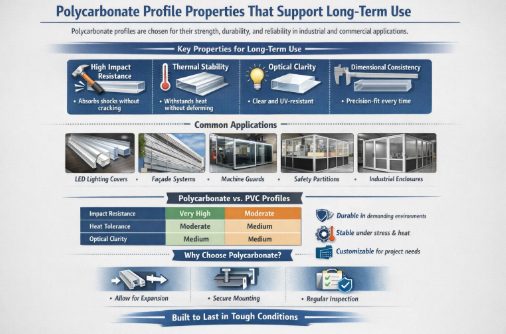
Key Properties That Support Long-Term Use
1. High Impact Resistance
Polycarbonate is known for its toughness. It can absorb sudden force without breaking.
This matters in:
- Public buildings
- Industrial equipment covers
- Transport and handling areas
Profiles made from polycarbonate reduce the risk of failure due to accidental impact.
- Thermal Stability
Many installations operate under continuous lighting or machinery heat.
Polycarbonate profiles:
- Handle higher temperatures than standard PVC
- Do not soften easily under normal operating conditions
- Maintain dimensional stability over time
This property supports consistent fit and function in long-running systems.
- Optical Clarity and Light Control
In lighting and display applications, clarity matters.
Polycarbonate offers:
- High light transmission
- Uniform diffusion when processed correctly
- Resistance to yellowing in controlled environments
This is why it is widely used for LED covers and protective light channels.
- Dimensional Consistency
For repeat production and large projects, consistency is critical.
Polycarbonate profiles:
- Hold tight tolerances during extrusion
- Match drawings accurately
- Support repeat orders without variation
This reduces assembly issues and saves time during installation.
Polycarbonate Profile Applications in Real Projects
Polycarbonate profile applications are spread across many industries, often in places people do not notice until something fails.
Common applications include:
- LED diffuser and protective lighting covers
- Façade and window system components
- Machine guards and safety enclosures
- Signage frames and display systems
- Industrial partitions and panels
In these uses, profiles are expected to perform quietly for years without replacement.
How Polycarbonate Compares with Other Plastic Profiles
Choosing the wrong material often leads to early failure. Here is a simple comparison from site experience.
| Property | Polycarbonate | PVC |
| Impact resistance | Very high | Moderate |
| Heat tolerance | High | Medium |
| Optical clarity | High | Medium |
| Long-term stability | Strong | Application dependent |
This is why buyers often shift to polycarbonate when performance issues appear with standard materials.
Installation Factors That Affect Longevity
Even the best material can underperform if installed poorly.
Installers usually focus on:
- Proper allowance for thermal expansion
- Secure but flexible mounting
- Clean cutting and finishing
Correct installation ensures the polycarbonate profile performs as designed over its full service life.
Custom Profiles for Repeat and Bulk Requirements
Large projects rarely work with generic shapes.
Custom polycarbonate profiles support:
- Exact fit with existing systems
- Clean integration with metal or glass
- Consistent appearance across locations
Manufacturers such as M3 Extrusion supply polycarbonate profiles based on drawings and technical requirements, helping OEMs and project teams maintain uniform output across bulk and repeat orders.
Maintenance and Lifecycle Benefits
From a facility management view, polycarbonate profiles reduce long-term effort.
They help by:
- Resisting cracks and breakage
- Staying stable under daily use
- Reducing replacement frequency
This lowers downtime and keeps systems functioning without constant intervention.
Choosing the Right Polycarbonate Profile in India
When selecting a polycarbonate profile in India, practical evaluation matters more than catalogue images.
Key checks include:
- Does the profile meet impact and heat requirements?
- Is the extrusion consistent across batches?
- Can the supplier support long-term repeat supply?
These questions help avoid mismatches between design intent and real-world performance.
Practical Takeaways for Buyers and Engineers
- Polycarbonate profiles are built for long-term use
- Impact resistance protects against daily wear
- Thermal stability supports continuous operation
- Consistent extrusion matters for repeat production
- Correct installation extends service life
Frequently Asked Questions
What makes polycarbonate profiles suitable for long-term use?
Polycarbonate profiles offer high impact resistance, thermal stability, and dimensional consistency. These properties allow them to perform reliably under continuous use, frequent handling, and temperature variation, making them suitable for long-term commercial and industrial applications.
Where are polycarbonate profiles commonly used?
Polycarbonate profiles are used in lighting covers, façade systems, machine guards, partitions, and display structures. They are chosen where strength, clarity, and durability are required over extended periods without frequent replacement.
How long does a polycarbonate profile last in normal use?
A well-manufactured polycarbonate profile can last many years under normal commercial or industrial conditions. Actual lifespan depends on material quality, operating temperature, exposure conditions, and correct installation practices.
Are polycarbonate profiles better than PVC profiles?
Polycarbonate profiles generally offer higher impact resistance and better heat tolerance than PVC. PVC may suit lighter applications, but polycarbonate is preferred where durability and long-term performance are critical.
Can polycarbonate profiles be customised for projects?
Yes, polycarbonate profiles can be extruded in custom shapes based on drawings and specifications. Custom profiles help ensure proper fit, consistent appearance, and repeatability across large or phased projects.
Do polycarbonate profiles require special maintenance?
Polycarbonate profiles require minimal maintenance. Regular cleaning and basic inspection are usually sufficient. Their resistance to cracking and deformation reduces the need for frequent replacement in demanding environments.
